


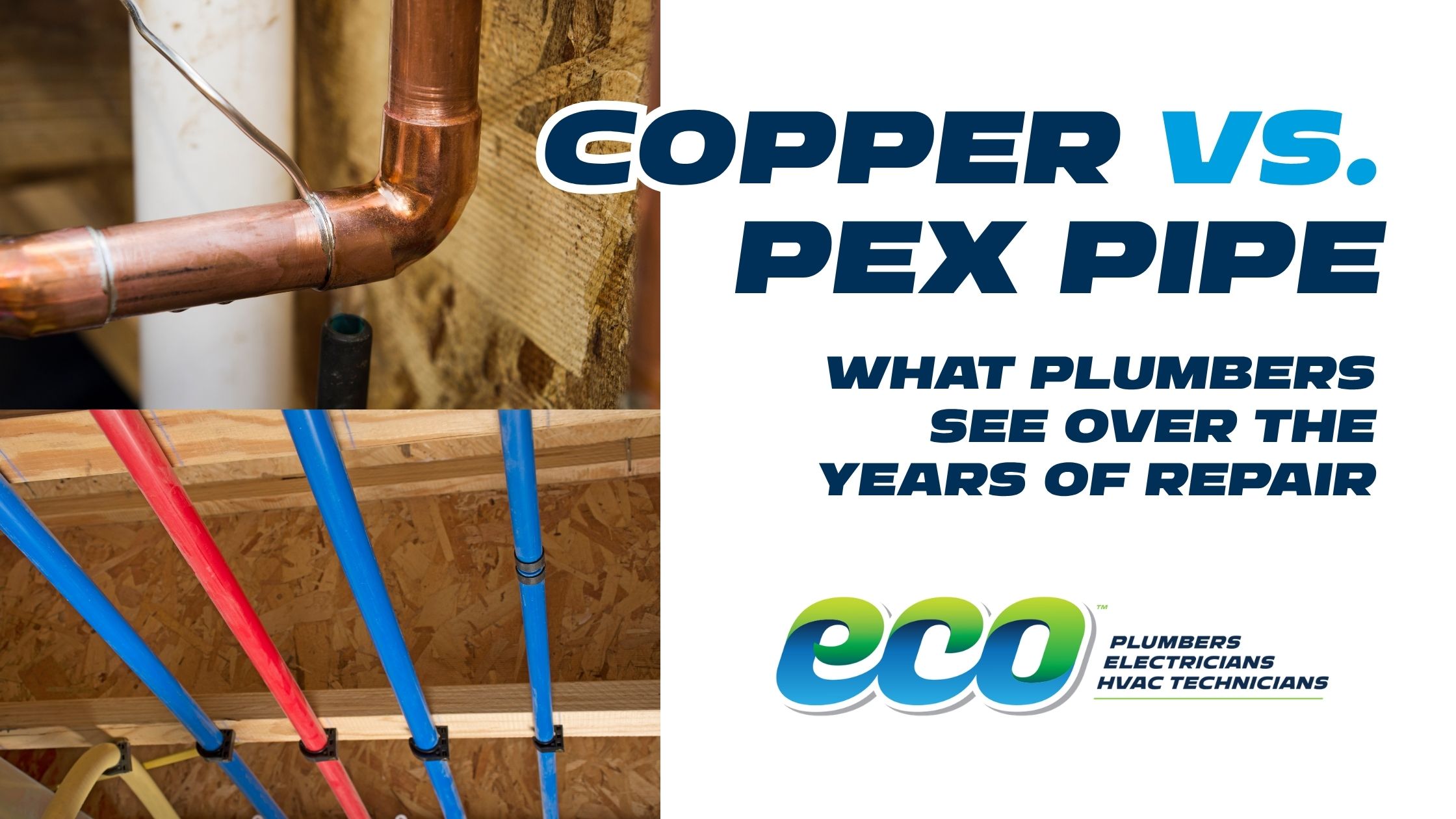
What's Ahead
If you’re planning a repipe or replacing a damaged section of plumbing, you’ve probably already read a handful of articles comparing copper and PEX pipe. Most of them recite the same specs: copper lasts longer on paper, PEX costs less to install. Are you left wondering which one will actually hold up in your home, or worried you’ll pick the “wrong” one and regret it in ten years?
Specs only tell you how a pipe is supposed to perform in ideal conditions. They don’t tell you what actually goes wrong once that pipe is sealed behind your walls for 10, 20, or 40 years.
That’s the part our plumbers see firsthand. Every week, technicians at Eco Plumbers, Electricians, and HVAC Technicians cut into walls, ceilings, and crawlspaces across Ohio and Kentucky to repair pipes that failed early, and the patterns are consistent enough to tell a far more useful story than a spec sheet.
Here’s the short version: copper failures usually trace back to water chemistry and age, showing up as pinhole leaks, greenish staining, and corroded joints. PEX failures usually trace back to installation mistakes, sun exposure, or rodent damage, not the material breaking down on its own.
What Plumbers See When Copper Pipes Fail
The most common copper failure our plumbers repair is a pinhole leak caused by pitting corrosion. This happens when water with the wrong chemistry, either too acidic or too soft, slowly eats through the pipe wall from the inside out. There’s often no warning until a small, pressurized leak shows up inside a wall, ceiling, or slab.
A few other copper issues show up again and again on service calls:
- Green or blue-green staining around fixtures, a visible sign that copper is leaching into the water supply
- Failed solder joints, especially on older systems where flux wasn’t fully cleaned off during the original installation
- Freeze damage, since rigid copper has little flexibility and can split when water inside it expands
- Lead solder in homes built before 1986, when lead-based solder was still commonly used on copper joints
None of this means copper is a poor material. Well-installed copper paired with balanced water chemistry can genuinely last 50 to 70 years. The Copper Development Association has even documented original copper systems still functioning after nearly 70 years. But once corrosion sets in, it tends to show up in multiple spots around the same time, which is why homeowners with aging copper systems often deal with several small leaks within the same year rather than just one.
What Plumbers See When PEX Pipes Fail
PEX rarely fails because the tubing itself wears out. When our team finds a failed PEX system, the cause is almost always something around the pipe, not the material itself.
The most frequent issue is a poorly seated fitting. PEX connections rely on crimp rings, clamps, or expansion fittings being installed to exact specifications. A crimp ring that’s slightly off, or a fitting that wasn’t fully expanded, can hold for months before it starts to weep or fail outright. That’s why installation quality matters just as much as the material choice.
Other PEX problems our plumbers see on a regular basis:
- Rodent damage in attics, crawlspaces, and unfinished basements, since PEX is softer than copper and easier for mice to chew through
- UV degradation on exposed runs near windows, garages, or sunlit crawlspace vents, since prolonged sunlight breaks down the tubing over time
- Chlorine-related breakdown, more common in older PEX-A and early PEX-B formulations, though modern PEX resists chlorine far better than pipe made even 15 years ago
- Kinking during installation, which restricts flow and creates a permanent weak point in the tubing
The takeaway from the field: most PEX failures are preventable with correct installation and protection from sunlight and pests. That’s different from copper, where failures are often tied to water chemistry a homeowner can’t fully control on their own.
Copper vs. PEX: Lifespan, Cost, and Performance Compared
Once you look past the failure patterns, the baseline specs are still worth knowing. According to The Home Depot’s professional plumbing guide, copper is generally rated to last 50 to 70 years, while PEX carries a roughly 50-year expected lifespan. Copper is more likely to crack when temperatures drop below 20 degrees for several hours, while PEX’s flexibility lets it expand instead of splitting in a freeze. On the flip side, copper resists UV light and rodents far better than PEX, and copper corrosion becomes more likely once water pH drops to 7 or below.
Factor | Copper | PEX |
Typical lifespan | 50–70 years | ~50 years |
Freeze resistance | Can crack in hard freezes | Flexes and resists bursting |
UV / sunlight exposure | Highly resistant | Degrades with prolonged exposure |
Rodent resistance | Highly resistant | Vulnerable, especially in crawlspaces |
Water chemistry sensitivity | Corrodes in acidic or soft water | Largely unaffected by pH |
Installation method | Cut, measure, and solder | Crimped, clamped, or expansion fittings |
Typical repipe timeline for residential home | 1–5 days | 1–3 days |
Material and labor cost | Higher | Lower |
Neither material is objectively “better” across the board. The right choice depends on your home’s water chemistry and climate exposure, your budget, and how the pipe will be run through your house.
Which Pipe Material Is Right for Your Home?
Since both materials have strengths tied to specific conditions, the decision usually comes down to a few practical questions:
- What’s your water chemistry like? Homes on well water or with naturally acidic water tend to see copper corrode faster, which makes PEX the more forgiving choice.
- How exposed will the pipe be? Runs through unconditioned crawlspaces, attics, or areas near sunlit windows favor copper’s resistance to pests and UV, unless the PEX can be properly insulated and shielded.
- What’s your budget for the project? PEX typically costs less in both material and labor, which matters most for a full whole-home repipe.
- What does your home already have? If you’re doing a partial repair, it’s often more practical to match the existing material rather than mixing systems, though a licensed plumber can transition between the two correctly when needed.
- Are you planning to sell in the next several years? Some buyers and inspectors still associate copper with higher-end construction, so resale expectations in your market are worth a conversation.
Choosing the Right Pipe for Your Home
At the end of the day, both copper and PEX are proven materials. Neither one is the “wrong” choice; the right one comes down to your home’s water chemistry, how exposed the pipe run will be, and your budget.
If you started reading this because you’re staring down a repipe decision, or because you’re already seeing the early warning signs of corrosion stains, a stubborn leak, a section of pipe that keeps failing, it’s easy to feel like you need to become an expert in metallurgy just to make the right call. You don’t. You just need to understand how each material actually behaves once it’s in your walls, which is exactly what this guide covered.
One thing we’d caution against: if you’re tempted to patch a failing section yourself before calling a plumber, it’s worth understanding the risks first. Read our guide, 5 Problems with DIY Plumbing Repairs in Your Home, before you pick up a wrench, since a DIY fix on the wrong material or the wrong fitting can turn a small leak into a much bigger repair.
Here at Eco Plumbers, Electricians, and HVAC Technicians. Our plumbers have repaired and replaced enough copper and PEX systems across Ohio and Kentucky to know what actually holds up in homes like yours. If you’re ready for an honest read on which pipe material makes sense for your situation, our team is ready to take a look.
FAQs
Can copper and PEX pipes be connected in the same system?
Yes. A licensed plumber can transition between copper and PEX using the approved fittings, which is common during partial repipes or repairs on older homes. Improper connections, whether it's two dissimilar metals or metal connected to plastic without the right fitting, can lead to premature failure at that joint. When that happens, it's not just a repair issue. A failed connection behind a wall or under a floor can leak for a while before it's noticed, leading to water damage to your home and belongings.
Does PEX affect the taste or safety of drinking water?
Modern PEX pipe is certified for potable water use and doesn't typically affect taste. Some homeowners notice a faint plastic-like odor from brand-new PEX, which usually fades after the system has been in use for a few weeks.
Is PEX safe to use on hot water lines?
Yes, PEX is rated for both hot and cold water lines. The color isn't just cosmetic. It's a system for identifying what each line carries. Red indicates hot water, blue indicates cold, and white or gray can handle either. You may also come across purple PEX, which is reserved for reclaimed or non-potable water from a treatment facility and should never be mistaken for a line safe to drink from.
How much does it cost to repipe a house with copper vs. PEX?
Copper material typically runs $2 to $8 per linear foot, while PEX runs closer to $0.50 to $2 per linear foot, before labor. But pipe cost is only part of the picture. Fittings add up fast, and depending on the type and material, a single fitting can run anywhere from around 50 cents to $20 or more.
A system with more turns, branches, or connection points will need more fittings, which can shift the total cost more than the pipe itself does. The total project cost depends heavily on your home's size, how accessible the existing pipe is, fitting count, and local labor rates, so an in-home estimate is the only way to get an accurate number for your house.
Will switching from copper to PEX affect my water pressure?
In most cases, no. A lot of factors influence water pressure, but the pipe material itself usually isn't one of them. What matters more is what you're comparing: the new pipe diameter, fittings, and fixtures versus what was previously in place. If your old copper system had corrosion buildup or undersized fittings, a properly sized PEX system can actually improve flow. Your plumber can walk you through exactly what's changing in your home's setup and what to expect.
How do I know if my current pipes need to be replaced instead of repaired?
Signs like recurring leaks in different areas, discolored or metallic-tasting water, or visibly corroded fittings usually mean the whole system is nearing the end of its life rather than one isolated failure.