

Are you tired of cold showers or skyrocketing energy bills? If you’re reading this, chances are you’re weighing your options between a tankless water heater and a traditional tank water heater. Maybe your current water heater is on its last leg. Or maybe you’re looking to be proactive and want to make a smart long-term decision. Either way, you’re thinking to yourself:
What’s the real difference between the two?
Which one is better for my needs and my wallet?
Here’s our promise. In this article, you’ll get a side-by-side comparison of a tankless and a traditional water heater. Not only that, but this guide is based on our expertise in installing thousands of water heaters in Greater Columbus, Dayton, Cincinnati, and Southern Ohio.
- How do Tank and Tankless Water Heaters Work?
- Water Heater Installation Costs: Tank vs. Tankless Pricing Breakdown
- Water Heater Energy Efficiency and Operating Costs
- Tank vs. Tankless Lifespan vs. Maintenance Needs
- Performance: Hot Water on Demand vs. Capacity
- Which Water Heater Is Right For You?
- Final Verdict: Should You Go Tankless or Stick With a Traditional Water Heater?
How do Tank and Tankless Water Heaters Work?
Before diving into costs and performance, let’s understand how each type of water heater actually functions. Why? Because how they operate affects everything from energy use and maintenance to comfort and installation logistics.
Let’s break it down.
Traditional Tank Water Heaters: Store and Maintain Hot Water
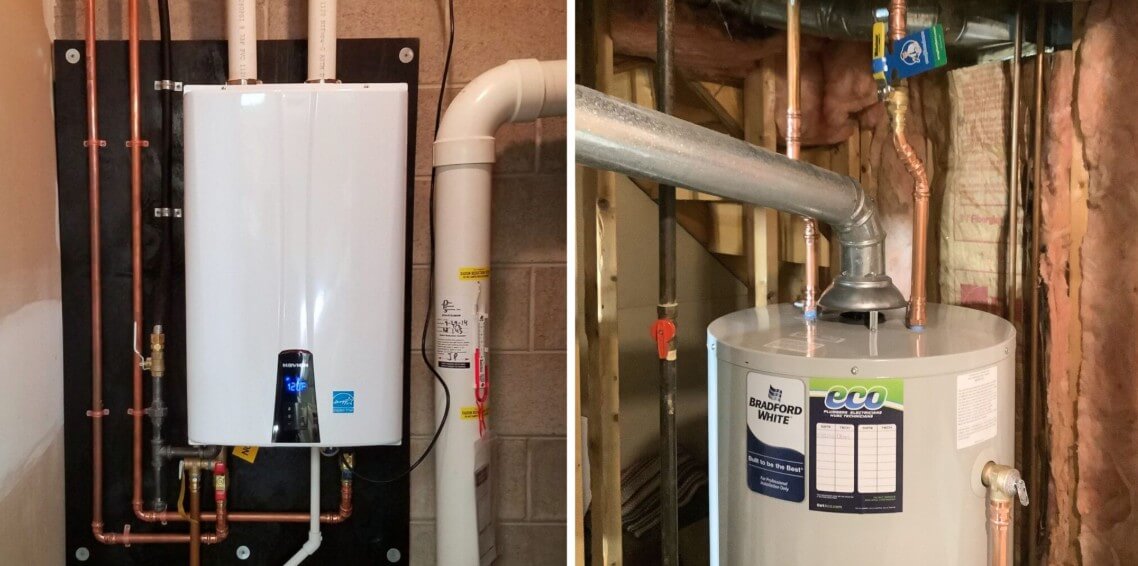
Traditional water heaters are insulated storage tanks, ranging in size from 30 to 80 gallons, that consistently heat water to a set temperature, whether you’re using it or not. A thermostat monitors the water temperature, and a gas burner or electric heating element kicks on to reheat the water as needed.
This is known as “standby heating.” Even when you’re asleep or at work, your tank is burning energy to keep water warm just in case someone turns on the faucet.
How It Works
- Cold water enters the bottom of the tank through a dip tube, a pipe inside a water heater that directs the incoming cold water
- The heating element or burner heats the water
- Hot water rises to the top and is pulled out when you open a hot water tap
- As water is used, cold water replaces it, and the cycle starts again
Pros
- Lower upfront cost: Often 50-70% cheaper than tankless units to purchase and install
- Familiar technology: Most plumbers are trained and experienced with tank-style water heaters
- Easier to install: Ideal for quick swaps with existing tank setups
Cons
- Limited hot water supply: Once the tank is empty, it takes 30-60 minutes to reheat
- Higher energy waste: Continuous reheating leads to standby heat loss and higher utility bills
- Bulkier footprint: These tanks take up floor space in basements, closets, or garages
Tankless Water Heaters: Heat Water On-Demand
Tankless water heaters skip the storage altogether. Instead of keeping a tank of hot water ready, they heat water instantly as it flows through the unit when a hot water tap is turned on. The result? A nearly endless supply of hot water, without the energy waste of keeping it warm all day.
How It Works
- You turn on the hot water tap
- Water flows through the unit and triggers a flow sensor that detects water movement and signals it to heat the water
- A gas burner or electric coil heats the water as it passes through a heat exchanger
- Hot water travels straight to your faucet or shower
Pros
- Endless hot water: As long as your unit can keep up with demand, you’ll never run out.
- Energy efficient: No energy is used when hot water isn’t needed. It’s great for reducing monthly bills with up to 24-34% more efficiency compared to tank-style water heaters.
- Compact design: Units are wall-mounted and about the size of a standard suitcase, freeing up storage space in your closet or basement.
Cons
- Higher upfront cost: Equipment and installation costs can be 2-3x more than tank-style units, though the high efficiency typically makes up for the cost difference of the install after 3-4 years.
- Potential flow limitations: Running multiple hot water sources at once (e.g., two showers + a dishwasher) can overload smaller units.
- Upgrades may be required: Switching from tank to tankless may involve electrical upgrades or gas line resizing, adding to the installation cost.
Key Takeaway: If your top priorities are low upfront cost and simplicity, a traditional tank water heater is a solid choice. If you value energy efficiency, space savings, and endless hot water, a tankless water heater may be worth the investment.
Water Heater Installation Costs: Tank vs. Tankless Pricing Breakdown
When comparing water heaters, the most immediate and often most painful question homeowners ask is, “How much is this going to cost me?” Let’s break it down by equipment, labor, and the hidden factors that can impact your final price.
Traditional Water Heater Cost
National Average: $1,600-$4,500+
What’s included in that price?
- Basic tank water heater
- Permits
- Installation materials
- Installation labor
- Removal of the old unit
Traditional tank water heaters are usually quick to install, especially if you’re replacing an existing tank system with a similar capacity and fuel type. Installers typically need just a few hours and won’t have to modify your plumbing or electrical systems.
Tankless Water Heater Cost
National Average: $2,400-$6,800+
What’s included in that price?
- Tankless water heater
- Permits
- Installation materials
- Additional materials and potential upgrades:
- Gas line enlargement (if switching from tank to gas tankless)
- Electrical panel upgrades (for electric tankless)
- Wall mounting brackets and venting materials
- Water softener (in areas with hard water)
- Installation labor
- Removal of the old unit
The cost range is so wide because tankless installation is more complex than tank water heaters. It’s not just a plug-and-play swap. Many homes weren’t originally built with tankless compatibility in mind, so installers often have to make significant system modifications. Unsure if your home would support a tankless? Schedule a FREE evaluation with us.
Water Heater Energy Efficiency and Operating Costs
When homeowners ask about water heaters, you’re usually not just concerned with the purchase price; you want to know what it will cost you month after month. This is where energy efficiency becomes a key deciding factor.
Let’s look at how each system affects your utility bills over time.
Traditional Water Heaters: Always On, Always Heating
Conventional tank water heaters operate on a simple but costly principle: they keep a tank of water hot 24/7, so it’s ready whenever you turn on the tap.
But here’s the downside. Even when no one’s using hot water, the systemis working, consuming energy to maintain the temperature, this is called standby heat loss.
Energy Bill Impacts
- Gas-powered tank systems typically use 30% more energy than tankless models over the course of a year
- For electric tanks, energy consumption can be even higher, especially in colder climates or homes with poor insulation
- Monthly energy costs for traditional systems can range from $30 to $50+, depending on water usage, fuel source, and unit efficiency
Tankless Water Heaters: Heat Only What You Use
Tankless systems take a smarter approach. Instead of heating water 24/7, they only fire up when you actually turn on a hot water tap.
This on-demand heating model eliminates standby losses entirely and helps homeowners cut down significantly on energy use. According to the U.S. Department of Energy,
“Tankless water heaters can be 24% to 34% more energy efficient than conventional storage tank water heaters for homes that use 41 gallons or less of hot water daily.”
For homes with higher daily usage (around 86 gallons), efficiency is still 8-14% higher, especially if multiple tankless units are installed in strategic zones
Energy Bill Impacts
- Homeowners could save $95-$180+ per year on energy bills
- Over a 15-20 year lifespan, that could add up to $1,800 in savings
| Water Heater Type |
Typical Efficiency % |
| Electric Tank |
92% |
| Gas Tank |
63% |
| Gas Powervent Tank |
69% |
| Gas Tankless |
95% |
| Heat Pump (Hybrid) Tank |
405%* |
*Heat Pump (Hybrid) Tank Water Heaters deliver 2-4x more heat energy than electric or gas water heaters.
Tank vs. Tankless Lifespan and Maintenance Needs
When deciding between a tank and tankless water heater, most homeowners want to know the most asked question: “Which one lasts longer?” But the better question is, “What will I need to do to keep it running well, and how often will I have to replace it?”
Let’s explore the differences in expected lifespan, required maintenance, and manufacturer support for each system.
| Feature |
Traditional |
Tankless |
| Average Lifespan |
8-12 years |
15-20 years |
| Maintenance |
Flushing 1x/year |
Descaling 1-2x/year |
| Manufacturer Warranty |
6-10 years |
10-15 years |
If you’re looking for a long-term solution with minimal operating costs, a tankless system clearly comes out on top. But, if you’re focused on ease of maintenance and low-stress replacements, a traditional tank might be more practical.
Performance: Hot Water On-Demand vs. Capacity
Traditional water heaters can run out of hot water. Once the tank is empty, you’ll wait 30-60 minutes for a refill.
Tankless water heaters offer endless hot water, as long as you don’t exceed their flow rate (measured in GPM: gallons per minute). They may struggle if you’re using lots of water all at once, though it is not common, as we size for the size of the home and the household, so you get the most out of your water heater.
Which Water Heater Is Right For You?
Here’s a breakdown based on lifestyle, budget, and usage needs.
| Consideration |
Choose Traditional If… |
Choose Tankless If… |
| Budget |
You want to spend less up front |
You can invest now for long-term savings |
| Usage |
You use moderate amounts of hot water |
You want endless hot water on demand |
| Lifespan |
You don’t mind the 10-year replacement cycle |
You prefer fewer replacements |
| Space |
You have plenty of space |
You want to free up a closet or basement space |
| Eco-Friendly |
You don’t mind less efficiency |
You want to reduce energy use |
Final Verdict: Should You Go Tankless or Stick with a Traditional Water Heater?
When it comes down to choosing between a tankless and a traditional water heater, you’re not just picking a piece of equipment; you’re making a decision that will impact your comfort, your energy bills, and your home’s efficiency for years to come.
We’ve explained the inner workings, upfront costs, long-term savings, and pros and cons of both systems. If your main concern is keeping costs low and sticking with something familiar, a traditional tank model might be the right fit. But if you’re aiming for long-term value, lower monthly bills, more storage space, and endless hot water, a tankless system could be well worth the investment.
After installing thousands of units throughout Greater Columbus, Dayton, Cincinnati, and Southern Ohio, one thing has become clear: homeowners who take time to understand the differences feel far more confident in their decision and far more satisfied with the outcome. That’s exactly why we created this guide: to empower you with the knowledge most companies won’t share!
Still unsure? That’s completely normal; every home is different, and the best solution depends on your unique lifestyle and budget. If you’d like help figuring out which water heater is right for you, contact us.
FAQs
Can I switch from a traditional to a tankless water heater?
Yes, but expect higher upfront costs and potentially plumbing rerouting or gas line upgrades to be able to support the system.
Are tankless water heaters electric or gas?
Both options exist! Gas units tend to have higher flow rates, while electric units are easier to install. Though at Eco, we do not recommend Electric Tankless Water Heaters as they are less efficient and, in most situations, are not as commonly installed in our service areas due to our colder climate causing them not to work properly.