

What's Ahead
If you’re considering a tankless water heater, you’ve probably asked one question above all others.
Will it actually lower my utility bills?
Unfortunately, finding a straightforward answer isn’t easy. Most information online relies on manufacturer estimates or ideal conditions, but your monthly gas and water bills are affected by much more than your water heater, including changing utility rates, weather, and household size.
To provide a more realistic answer, we analyzed 24 months of actual utility data from a Columbus homeowner, Eva, after she replaced two traditional tank water heaters with a single tankless system.
This case study examines her monthly natural gas and water bills alongside real-life factors such as utility rate increases, changes in household occupancy, and periods of higher water usage when guests visited.
By the end of this article, you’ll understand what Eva’s two years of utility data actually reveal, what conclusions can and cannot be drawn from the numbers, and whether a tankless water heater delivered value beyond the monthly utility bill.
A 24-Month Case Study from a Columbus Homeowner
In November 2024, Columbus homeowner Eva replaced two traditional tank water heaters with a single tankless water heater. Instead of relying on estimates or manufacturer claims, she decided to track her utility bills over the next two years to see how the new system performed in everyday life.
Throughout the 24-month period, she recorded more than just her monthly water and natural gas bills. She also noted factors that could affect her utility costs, including:
- Changes in natural gas and water rates
- Household occupancy
- Overnight guests
- Vacation periods
- Seasonal changes in energy use
By documenting these variables alongside her monthly bills, Eva created a much more realistic picture of tankless water heater ownership than a simple before-and-after comparison could provide.
Monthly Natural Gas Bills
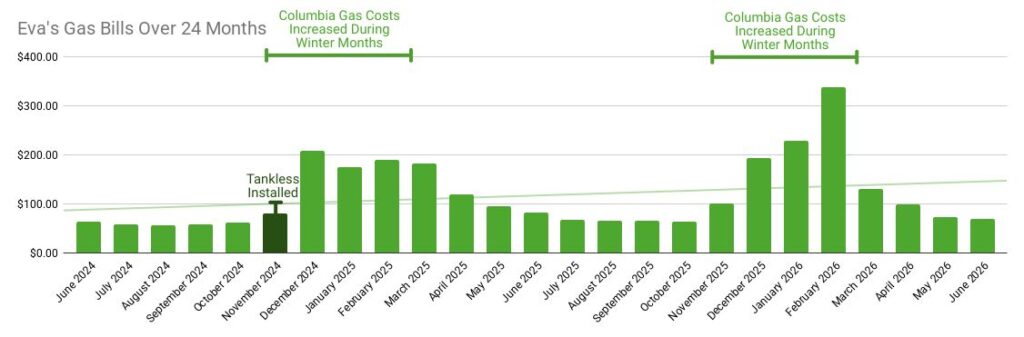
The chart above shows how Eva’s monthly natural gas bills fluctuated over two years. While winter bills naturally increased and gas prices changed during the study, the data provide valuable context for evaluating the tankless water heater’s performance over time instead of focusing on a single month’s bill.
Monthly Water Bills
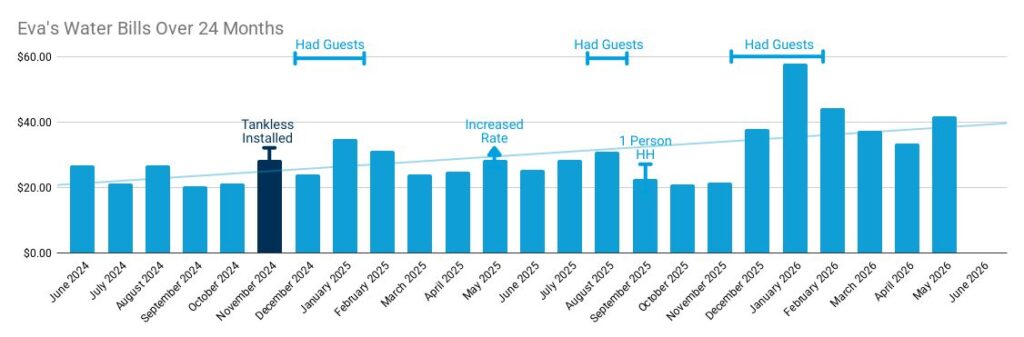
The water bill data tells a similar story. Rather than remaining perfectly consistent, costs changed as utility rates increased and household usage fluctuated. Looking at the complete trend helps explain why evaluating a tankless water heater requires more than simply comparing one bill before installation with one bill afterward.
What Happened to Natural Gas Costs?
One of the biggest challenges in evaluating the savings from a tankless water heater is separating the equipment’s performance from everything else that affects a utility bill. During Eva’s 24-month tracking period, Columbia Gas rates increased significantly, particularly during the winter of 2025 and 2026. As a result, a higher gas bill doesn’t necessarily mean the tankless water heater used more energy, it just means that the increased costs are hindering the potential savings from a tankless water heater.
There were other variables, too, like a gas stove, oven, and dryer. Eva intentionally looked for ways to reduce her overall heating costs by:
- Keeping the thermostat set to 65°F
- Dressing warmer indoors
- Using throw blankets during the winter
Because of these changes, it’s impossible to calculate exactly how much of her monthly gas bill was influenced by the tankless water heater alone.
Even so, Eva believes the system helped reduce the impact of rising gas prices.
“I suspect that not heating hot water continuously in a tank has helped minimize peak bills from Columbia Gas price increases, since with tankless, I only heat water when I need it.”
That’s an important takeaway. Rather than claiming dramatic monthly savings, Eva noticed that the tankless water heater may have helped offset some of the higher energy costs caused by increasing natural gas rates. It’s a more nuanced conclusion than many marketing claims, but it’s also one that’s grounded in two years of real-world experience.
Water Bills Tell a Similar Story
Eva’s water bills are also difficult to compare month to month because the water heater was not the only thing that changed during the study period.
During the 24-month tracking period:
- Del-Co Water changed its residential rate structure
- Eva’s household decreased to one full-time occupant
- Some months included overnight guests
- Water usage naturally changed from month to month
As Eva explained:
“It’s hard to tell from the report, though, since variables like price increases occurred.”
That context matters. Her average monthly water bill increased from roughly $26 per month before the utility rate change to about $31 per month afterward, even though fewer people were living in the home full-time.
Because the rate structure changed during the study, the water bill data cannot prove whether the tankless water heater directly increased or decreased water costs. What it does show is that real-world utility savings are rarely affected by one factor alone.
The Biggest Benefits Weren't Just About Utility Bills
After reviewing two years of utility data, one thing became clear: the biggest benefits of installing a tankless water heater weren’t necessarily reflected on Eva’s monthly bills.
Instead, they showed up in her day-to-day experience of living with the system.
More Basement Space
Before the upgrade, Eva’s home had two side-by-side tank water heaters taking up valuable floor space in the basement. Replacing them with a single tankless unit opened that area for storage and other uses.
For homeowners with limited basement space, reclaiming several square feet can be a meaningful benefit that’s impossible to measure on a utility bill.
As Eva put it:
“I do like the upgraded equipment for the future resale value of my home. Also, the placement in my basement freed up the space of two side-by-side water heaters.”
Hot Water When You Need It
Another advantage of a tankless system is how it delivers hot water. Instead of storing and reheating a tank of water throughout the day, it heats water on demand as you use it.
That means you don’t have to wait for a storage tank to recover after heavy use, making it a good fit for households with high hot water demand or multiple people showering back-to-back.
Eliminating Standby Heat Loss
Traditional tank water heaters continually reheat stored water to maintain the set temperature, even when no one is using hot water. This constant reheating, known as standby heat loss, consumes energy throughout the day.
A tankless water heater eliminates most of that standby energy use by heating water only when a faucet or appliance calls for it. While the exact utility savings vary from home to home, this design is one of the primary reasons many homeowners choose to make the switch.
What This Case Study Can and Can’t Tell Us
One of the most valuable aspects of this case study is its honesty. While Eva tracked her utility bills for 24 months, the data doesn’t support making sweeping claims about exactly how much money a tankless water heater saved.
Too many variables changed during the study, including:
- Natural gas prices
- Water rate increases
- Household size
- Seasonal weather
- Overnight guests
- Vacation periods
Because of these factors, it would be misleading to say the tankless water heater saved a specific dollar amount each month or reduced energy costs by a certain percentage.
What the data does show is something just as valuable. Despite rising utility rates and changing household conditions, Eva remains happy with her decision to install a tankless water heater. The added space in her basement, the convenience of on-demand hot water, and the confidence that she’s no longer heating a tank of water around the clock have made the investment worthwhile in her eyes.
Sometimes, the most honest answer isn’t a precise number. It’s understanding the full ownership experience and deciding whether those benefits align with what matters most to you.
Should You Install a Tankless Water Heater?
If you’re expecting a tankless water heater to cut your utility bills in half overnight, it’s important to set realistic expectations. While some homeowners do see lower energy costs, your actual savings depend on several factors, including:
- The efficiency and age of your current water heater
- Your household’s hot water usage
- Local natural gas and water rates
- The quality of the installation
- The size and efficiency of the new tankless unit
As Eva’s experience demonstrates, it’s often impossible to attribute changes in your utility bills to the water heater alone. However, many homeowners decide a tankless system is worthwhile because of the combination of financial, practical, and lifestyle benefits it provides.
Factor | What to Expect |
Monthly utility savings | Possible, but they vary depending on your home, energy rates, and hot water usage |
Hot water availability | Continuous hot water for as long as the system can meet your home’s demand |
Energy efficiency | Eliminates most standby heat loss by heating water only when you need it |
Space savings | Wall-mounted design frees up valuable floor space compared to traditional tank water heaters |
Equipment lifespan | Tankless water heaters typically last twice as long as conventional tank models when properly maintained |
Upfront investment | Higher installation costs than many traditional water heaters, but potentially lower operating costs over time |
The biggest takeaway from Eva’s case study is that evaluating a tankless water heater isn’t just about comparing one utility bill to another. It’s about considering the complete ownership experience, including energy efficiency, convenience, available space, upgraded equipment longevity, and your household’s unique hot water needs.
If those benefits align with your priorities, a tankless water heater may be a worthwhile investment, even if your monthly savings aren’t dramatic.
Should You Invest in a Tankless Water Heater?
If you came to this article looking for a definitive dollar amount that a tankless water heater will save you each month, Eva’s 24-month case study shows that the answer isn’t that simple. Utility rates, weather, household size, and daily habits all play a role, making it nearly impossible to isolate the water heater’s impact on your monthly bills.
What this real-world data does show is that a tankless water heater can deliver value in ways that extend beyond utility savings. From reclaiming basement space to eliminating standby heat loss and providing hot water on demand, Eva’s experience demonstrates why many homeowners are happy with their investment, even when the financial savings aren’t easy to quantify.
If you’re trying to decide whether a tankless water heater is the right choice for your home, your next step is understanding the full investment. Read our guide, Tankless Water Heater Installation: Is It Worth The Investment?, to learn about installation costs, long-term value, and the factors that determine whether a tankless system makes sense for your home.
At Eco Plumbers, Electricians, and HVAC Technicians, we believe homeowners make the best decisions when they have honest, transparent information. Whether you’re still researching or you’re ready to replace your water heater, our team is here to help you choose the solution that best fits your home, budget, and long-term goals.
FAQs
How long does it take to recover the cost of a tankless water heater?
The payback period varies depending on your installation cost, energy rates, and hot water usage. Some homeowners recover the additional upfront investment through lower operating costs over time, while others value the longer lifespan, space savings, and convenience more than the monthly utility savings. If you're evaluating the financial return, consider both energy savings and the potential for fewer replacements over the life of the system.
Do tankless water heaters require more maintenance than traditional water heaters?
No. Most manufacturers recommend flushing a tankless water heater once a year to remove mineral buildup, just like a tank-style water heater, especially in areas with hard water. Regular maintenance helps maintain efficiency, extends the unit's lifespan, and may be required to keep the manufacturer's warranty in effect.
Can every home be converted to a tankless water heater?
Not always. Some homes may need electrical upgrades, larger gas lines, new venting, or plumbing modifications before a tankless water heater can be installed safely and efficiently. A professional assessment can determine whether your current home's infrastructure is compatible and identify any additional installation costs before you commit to the project.