


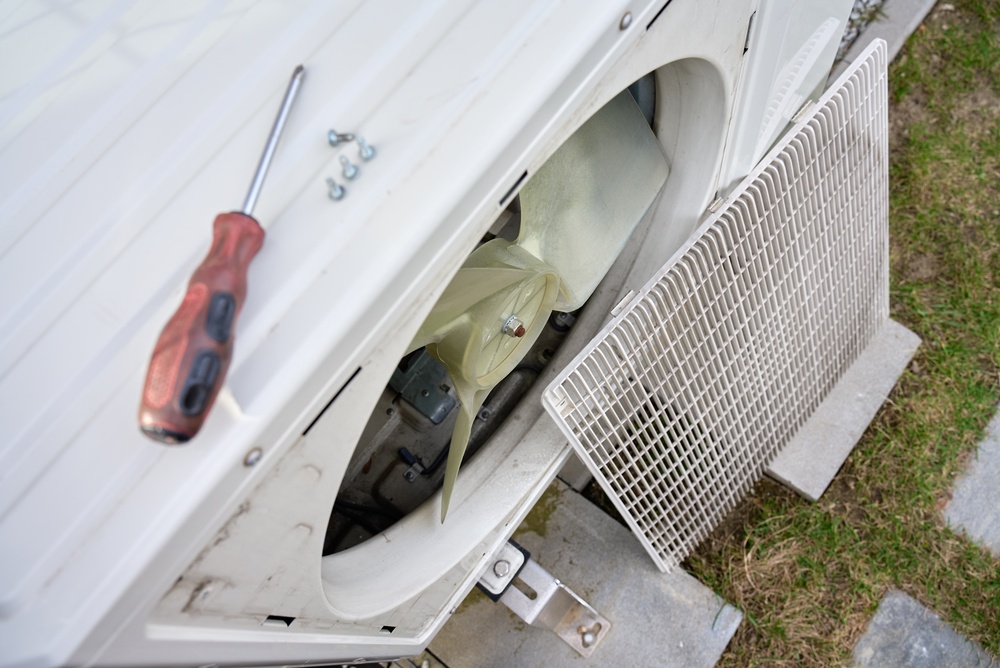
The first really cold night of the year has a way of finding every weak spot in a heating system.
You wake up and the house feels a few degrees off. The thermostat says 68, but it sure doesn’t feel like it. You put your hand over a vent and the air is just… lukewarm. Outside, the heat pump is humming away, maybe with a sheet of ice creeping up the sides.
Heat pumps are tough, but they work hard here. In Cincinnati, the same unit cools your home through humid summers and heats it through damp, freezing winters. When something starts to go wrong, it usually shows up as one of a handful of familiar problems.
We’re Eco Plumbers, Electricians, and HVAC Technicians, and we’ve been fixing heat pumps across Cincinnati since 2023. Here’s what those problems usually mean, what you can safely check yourself, and when it’s time to call for heat pump repair in Cincinnati, OH.
Key Takeaways
- Most heat pump problems show up as weak heat, ice that won’t clear, strange noises, or a system that won’t stop running.
- A few things are worth checking first: the filter, the thermostat settings, the breaker, and the space around the outdoor unit.
- Refrigerant, electrical parts, reversing valves, and compressors need a licensed heat pump technician.
- Backup or “aux” heat running all the time usually means something’s wrong, and it can make your electric bill jump.
- If your heat pump is older than 12 to 15 years and needs a major repair, it may be time to compare repair against replacement.
- Catching problems early almost always costs less than waiting for a full breakdown.
Quick Checks Before You Call for Heat Pump Repair
Before you pick up the phone, these take five minutes and sometimes solve the problem:
- Check the thermostat: Make sure it’s set to “heat” or “cool,” not “off” or “emergency heat,” and that the batteries aren’t dead.
- Look at the filter: A clogged filter can choke airflow and make the system struggle or freeze up.
- Check the breaker panel: Heat pumps often have two breakers, one for the indoor unit and one for the outdoor unit.
- Walk outside: Clear away leaves, snow, or anything blocking the outdoor unit. Keep at least two feet of space around it.
- Give defrost a few minutes: In winter, steam and a pause in heat can just be a normal defrost cycle.
If you’ve checked all of that and it’s still not right, it’s time for a pro. Don’t open panels or try to add refrigerant yourself. That’s where safety risks and expensive mistakes happen.
Common Heat Pump Problems and What They Usually Mean
Here are the issues we see most often in Cincinnati homes.
| What’s happening | Likely cause | Can you check it? | Needs a pro? |
| Blowing lukewarm or cold air in heat mode | Low refrigerant, bad reversing valve, failing defrost control | Check thermostat and filter | Yes |
| Outdoor unit covered in ice that won’t clear | Defrost control or sensor failure, low refrigerant, blocked airflow | Clear snow and debris | Yes, if it lasts more than a few hours |
| Running constantly but never reaching temperature | Low refrigerant, dirty coils, duct leaks, undersized system | Change the filter | Yes |
| Turning on and off every few minutes | Thermostat issue, refrigerant problem, oversized system, electrical fault | Check thermostat placement and batteries | Yes |
| “Aux” or “Emergency heat” on all the time | Heat pump not keeping up, defrost or thermostat problem | Confirm it’s not set to emergency heat | Yes |
| Grinding, squealing, or banging noises | Worn motor bearings, loose fan blade, compressor trouble | Turn it off to prevent damage | Yes |
| Buzzing or humming, but fan won’t spin | Failed capacitor or contactor | Check the breaker | Yes |
| Hissing or bubbling sounds | Possible refrigerant leak | No | Yes |
| Water leaking near the indoor unit | Clogged condensate drain or frozen indoor coil | Check the filter | Yes |
| Breaker keeps tripping | Electrical short, failing compressor or motor | Don’t keep resetting it | Yes |
Why Heat Pumps Freeze Up in Cincinnati Winters
A little frost on your heat pump in winter is normal. Cincinnati’s damp air and temperatures hovering around freezing are exactly the conditions that build frost on an outdoor coil. Your heat pump handles it with a defrost cycle. It briefly reverses, melts the ice, and then goes back to heating. That’s the steam you sometimes see.
The problem is when ice keeps building and never clears. A thick block of ice around the coil means the defrost system isn’t doing its job, or something else, like low refrigerant or poor airflow, is making it worse. If it sits like that, it can damage the fan and the coil.
Please don’t chip at it with a shovel or pour hot water on it. Shut the system off at the thermostat and call us.
Why Your Electric Bill Spikes When Something’s Wrong
When a heat pump can’t keep up, it leans on its backup heat. That’s usually electric resistance heat, and it costs a lot more to run. The Department of Energy points out that backup heating is generally more expensive to operate, and that a neglected heat pump can use 10% to 25% more energy than a well-maintained one.
So if your bill jumps in December and the “aux heat” light seems to always be on, that’s not just a comfort problem. Your system is telling you something’s off.
Repair or Heat Pump Replacement?
Not every problem means a new system. A capacitor, a contactor, a defrost board, or a drain clog is usually a straightforward heat pump repair.
Bigger issues are a different conversation. A failed compressor, a major refrigerant leak, or a cracked coil on an older system usually means it’s time to compare repair against replacement. Here’s how we’d weigh it:
- Age. If your heat pump is 12 to 15 years old or more, putting a lot of money into it can be like buying new tires for a car with a failing transmission.
- Refrigerant. Older systems may use R-22, which has been phased out and is expensive to recharge. Production of R-410A is also being cut back over the next decade, which will likely affect service costs. New systems use A2L refrigerants like R-454B and R-32, with built-in leak sensors.
- Repair history. If this is the third repair in two years, the money may be better spent on something new.
- Comfort and bills. A newer, right-sized system can make a real difference in both.
We’ll lay out both options honestly, with upfront pricing on each. One thing to keep in mind if you’re shopping around: the federal 25C tax credit for heat pumps ended for systems installed after December 31, 2025. If someone’s quote still counts on it, ask questions.
What to Expect From an Eco Heat Pump Technician
When you call us for heat pump service in Cincinnati, OH, a NATE-certified technician comes out, listens to what you’ve noticed, and diagnoses the actual problem. We don’t just start swapping parts. You’ll get a clear explanation and an upfront price before we fix anything.
Every repair is backed by our Eco Guarantees. We protect your home, clean up after ourselves, and if something isn’t right within a year, we come back and make it right. We can also set you up with EcoFi Monitoring, so you can keep an eye on your system’s health from an app and catch problems before they turn into a no-heat night.
Our founder, Aaron Gaynor, restarted his business with a $50 loan after losing everything in 2007. He built Eco on one promise: we come through for you when you need us to. When it’s 15 degrees out, and the house is getting colder, that’s exactly when it counts.
“Don’t wait for your heat pump to fail in the middle of winter. Call Eco Plumbers at 513-443-1169 today for fast, reliable repair in Cincinnati!”
FAQs
1. How much does heat pump repair cost in Cincinnati, OH?
It depends on the problem. A capacitor or drain clog costs far less than a compressor or a refrigerant leak. With Eco, you’ll always know the price before we start.
2. Why is my heat pump running but not heating?
It could be in a defrost cycle, which is normal and short. If it keeps blowing cool air, the cause is often low refrigerant, a stuck reversing valve, or a failed defrost control.
3. Is it safe to run my heat pump on emergency heat?
For a short time, yes. It’ll keep you warm, but it’s expensive to run. Use it to get by until a technician can fix the heat pump.
4. How long does a heat pump last in Cincinnati?
Many last 12 to 15 years or more with regular maintenance. Skipping tune-ups usually shortens that.
5. Can a frozen heat pump fix itself?
Light frost clears during normal defrost cycles. Thick ice that stays for hours needs a professional to find out why.