


What's Ahead
It’s the kind of thing you don’t think about until you’re standing in your basement in February, staring at a burst pipe behind your outdoor spigot. A cracked hose bib is one of the most common (and most preventable) winter plumbing failures we see across Ohio and Kentucky.
At Eco Plumbers, Electricians, and HVAC Technicians, we’ve repaired and replaced thousands of outdoor faucets across Greater Columbus, Dayton, Cincinnati, and Southern Ohio, and the pattern is consistent. Homes with properly installed frost-free hose bibs rarely freeze.
In this article, you’ll learn exactly how a frost-free hose bib differs from a standard hose bib, why that difference matters once temperatures drop, and how to tell which one is currently on your house.
What Is a Standard Hose Bib?
A standard hose bib is the basic outdoor faucet most homes were built with decades ago, and it’s still common on houses that haven’t been updated with a frost-free hose bib. The shutoff valve sits right where the spigot meets your exterior wall, which means the section of pipe holding water runs through the coldest part of your home: the wall cavity itself.
That matters because whatever water is sitting in that short run of pipe when the temperature drops is fully exposed to outdoor cold, with nothing but a thin wall between it and the weather. When that trapped water freezes, it expands by roughly 9%, and something has to give, usually the pipe or the fitting behind your wall. You won’t always see the crack right away either. Many homeowners don’t discover a frozen, split hose bib until spring, when they turn the water back on, and it leaks into the wall or basement instead of out the spigot.
What Is a Frost-Free Hose Bib?
A frost-free hose bib (also called a frost-proof or freeze-proof sillcock) solves this problem with a longer design. Instead of the valve sitting at the exterior wall, it’s mounted on the end of a long stem, typically 8 to 12 inches, that extends back into your home’s heated interior space.
The actual shutoff valve lives inside the warm part of your house, not out at the wall, so there’s no exposed pocket of water left sitting in the cold to freeze.
The stem is also installed with a slight downward pitch toward the outside, so once you turn the handle off, gravity drains the remaining water out through the spigot instead of leaving it trapped in the pipe. It’s a small design change, but it’s the difference between a faucet that survives an Ohio winter and one that has the potential not to.
The Key Difference: Where the Shutoff Valve Lives
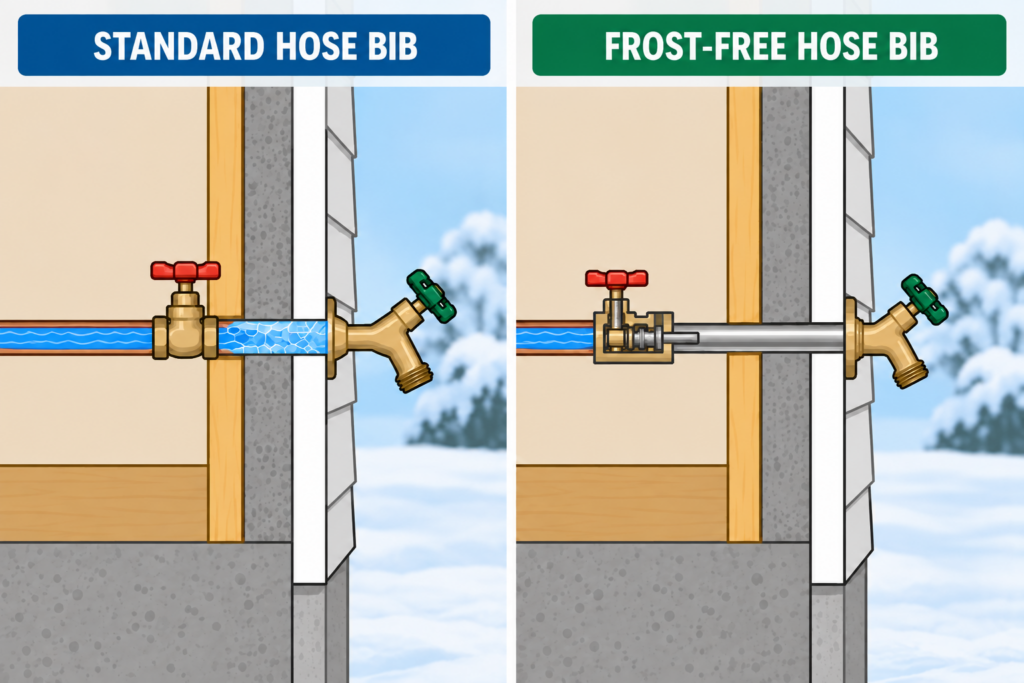
The entire difference between these two fixtures comes down to where the water gets shut off, and therefore where the last bit of water in the pipe ends up sitting. A standard hose bib shuts off at the wall, leaving water exposed to outdoor temperatures. A frost-free hose bib shuts off deep inside your home’s heated space, so the vulnerable section of pipe simply doesn’t exist.
Everything else, the exterior appearance, the handle, the connection threads for your garden hose, looks essentially the same from the outside. You genuinely can’t always tell which one you have just by glancing at your spigot, which is exactly why so many homeowners are caught off guard.
Why Freeze Protection Matters in Ohio and Kentucky Winters
Ohio and Kentucky both see winters that push well past the threshold where pipes are at real risk. According to Consumer Reports, frozen pipes generally occur once temperatures drop below 20°F, and freezing can start happening even sooner in uninsulated spaces, which describes the wall cavity behind most standard hose bibs perfectly.
Columbus, Dayton, Cincinnati, Southern Ohio, and communities just across the river in Northern Kentucky all see multiple stretches of sub-20°F weather every winter, sometimes for days at a time. If your home still has a standard hose bib, it isn’t a question of if it will eventually freeze; it’s a question of which winter.
How to Tell Which One Your Home Has
You can usually check this yourself in a couple of minutes:
- Go to your basement, crawlspace, or the interior wall behind your outdoor faucet and look for the shutoff valve. If it’s mounted several inches to a foot inside the wall, on a visible pipe stem, you have a frost-free hose bib.
- If you can’t find a separate shutoff valve at all inside, and the only handle is the one outside at the spigot, you likely have a standard hose bib.
- Check the length of the spigot itself from outside. Frost-free units often have a slightly longer housing where they meet the wall, though this isn’t always visible.
If you’re not sure after checking, that uncertainty is itself worth a phone call before winter, not after a pipe has already split.
The One Mistake That Freezes Frost-Free Hose Bibs Anyway
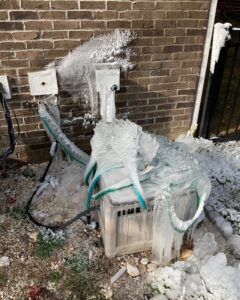
Here’s something we run into constantly: a frost-free hose bib that froze and burst even though it was installed correctly. In almost every case, the cause is the same: a garden hose was left connected over the winter.
A hose left attached to a frost-free spigot blocks the water from draining back out after you shut it off, which traps water in the stem exactly the way a standard hose bib does, defeating the entire purpose of the design. The fix costs nothing: disconnect every hose, coil it up, and store it before the first hard freeze each year. It’s the single easiest way to protect a frost-free hose bib you already have.
Should You Upgrade to a Frost-Free Hose Bib?
If your home currently has a standard hose bib, upgrading to a frost-free model is one of the more straightforward, affordable ways to prevent a winter plumbing failure, especially compared to the cost and disruption of repairing a burst pipe inside a finished wall. It’s a retrofit most licensed plumbers can complete in a single visit, without opening up drywall in most cases.
If you already have a frost-free hose bib, the fix is even simpler: just remember to disconnect your hoses before the cold sets in, and you likely won’t need to think about this again.
The Bottom Line on Frost-Free vs. Standard Hose Bibs
A standard hose bib and a frost-free hose bib might look nearly identical from your driveway, but only one of them is actually built to survive an Ohio winter. The difference comes down entirely to where the shutoff valve sits, at the exposed exterior wall on a standard bib, or safely inside your home’s heated space on a frost-free one.
If you already know your home has a standard hose bib, or you’re not sure which one you have, now is the time to check, before the first hard freeze does the checking for you. Catching that now is a lot less expensive than dealing with it after a pipe has already cracked. If you want to see what you could be facing either way, How Much Does It Cost to Repair a Frozen Outdoor Faucet? breaks down real repair and upgrade pricing, from a simple thaw to a full pipe replacement.
Winter plumbing problems don’t wait for business hours, and neither do we. Follow us on Facebook, Instagram, and TikTok for more quick tips like this one, behind-the-scenes content of our technicians in action, and seasonal reminders before the next hard freeze hits. If you’d like a licensed plumber to check which hose bib you have or handle the upgrade for you, visit our plumbing services page to get started.
FAQs
Does homeowners insurance cover damage from a frozen hose bib?
Many homeowners insurance policies cover sudden water damage from a burst pipe, but coverage can depend on whether the damage was considered preventable, such as failing to maintain reasonable heat in the home while you were away. It's worth a quick call to your provider before winter to confirm what your specific policy covers.
Can I still use a hose-end sprinkler or timer with a frost-free hose bib?
Yes, a frost-free hose bib works like any other spigot while something's attached and the weather's warm. The only time it matters is at the end of the season, when that sprinkler, timer, or hose needs to come off completely so the line can drain the way it's designed to.
Does installing a frost-free hose bib require a certain wall thickness?
Yes, the stem has to be long enough to reach from the exterior wall into your home's heated interior space, so wall thickness and insulation can affect which length is right for your home. That's part of why a professional measurement matters before the fixture is ordered.
Should I replace every hose bib on my house at once, or just the one that failed?
Not necessarily. Many homeowners replace them one at a time as each one fails or as they update different areas of the home. That said, if one standard hose bib has frozen, any others of the same style on your house are just as exposed, so it's worth having them all checked at the same time.
Can a frost-free hose bib freeze if it's installed in an unheated garage or addition?
It can, since the design only works if the interior end of the stem actually sits somewhere heated. If the wall it's mounted in backs up to an unheated garage, sunroom, or addition rather than a heated living space, that's worth flagging to whoever installs it.