


What's Ahead
Maybe you saw a rain barrel at a neighbor’s house and wondered if you could set one up yourself. Maybe you’re tired of watching hundreds of gallons run off your roof every time it storms, only to pool in your yard or seep toward your foundation. Or maybe you simply heard someone say, “You know that’s illegal in some states, right?” and now you’re not sure where Ohio stands.
At Eco Plumbers, Electricians, and HVAC Technicians, we work daily with the plumbing codes and local health district permitting rules that govern how water is used and moved through Ohio homes, and as a company built around eco-friendly home solutions, we get this question a lot. That’s the same regulatory ground that determines what’s legal when it comes to rainwater.
In this article, you’ll find out whether collecting rainwater in Ohio is legal, when the state requires a permit, and what “private water system” rules mean for a simple rain barrel versus a full drinking-water cistern.
Is It Legal To Collect Rainwater in Ohio?
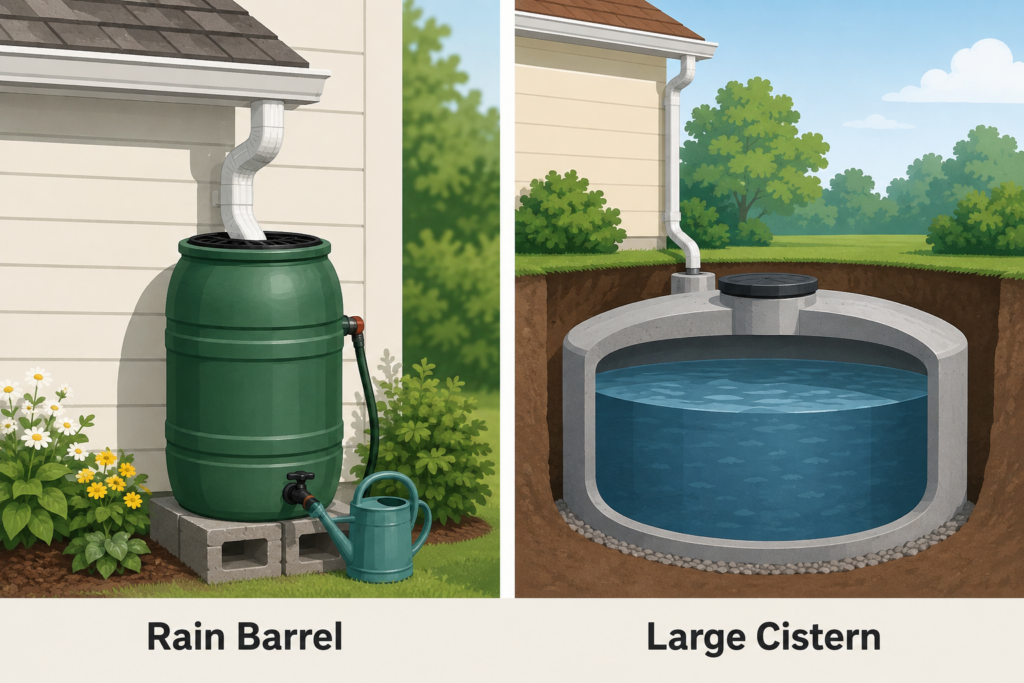
Yes, Ohio state law doesn’t prohibit residents from collecting it, whether that’s a $100 rain barrel under a downspout or a larger cistern system feeding a garden or irrigation line. Ohio actually goes further than most states by allowing collected rainwater to be treated and used as a household drinking water source, as long as the system meets state health requirements, something plenty of other states don’t permit at all.
Most of the confusion comes from mixing up “legal” with “unregulated.” Collecting rainwater is legal in Ohio. Using it for certain purposes, especially drinking, is regulated, meaning there are rules to follow, not a ban to work around. Those are two very different things, and understanding that distinction is what keeps you on the right side of Ohio law as you decide what kind of system makes sense for your home.
What Ohio Law Actually Regulates
Ohio’s rules around rainwater fall under the Ohio Department of Health’s Private Water Systems Program, which is governed by Ohio Revised Code Sections 3701.344 through 3701.347 and Ohio Administrative Code Chapter 3701-28.
A “private water system” includes rainwater cisterns, wells, ponds, springs, and hauled water storage tanks that supply drinking water to fewer than 25 people per day and have fewer than 15 service connections. If your rainwater setup is only feeding a garden, a rain barrel, or an irrigation line, it does not fall under these regulations at all. The rules only come into play once rainwater is collected as a household water supply, meaning it’s piped indoors and used for drinking, cooking, bathing, or flushing toilets.
That means:
- A rain barrel collecting runoff for your flower beds: no permit needed
- A cistern supplementing your lawn irrigation: no permit needed
- A cistern or rainwater system supplying water inside your home for daily use: regulated as a private water system requires a permit from your local health district
When Do You Need a Permit To Collect Rainwater in Ohio?
You need a permit when your rainwater system is designed to function as a household water supply, not just an outdoor collection barrel. Before construction begins, Ohio requires an application and site plan to be submitted to your local health district.
Once approved, a private water system used for drinking must also meet ongoing standards, including:
- Construction standards set by the Ohio Department of Health to prevent contamination
- Continuous disinfection, since rainwater cisterns are required to use a chlorine, iodine, ozone, or UV disinfection system
- Water testing through a certified laboratory to confirm the water is safe
- Clear labeling on any outlet supplying non-potable rainwater, so no one mistakes it for treated drinking water
If you’re only using rainwater outdoors, none of this applies to you. These requirements exist specifically to protect people who are drinking or cooking with the water, not people watering tomatoes.
The Good News for Most Ohio Homeowners
If your goal is simply to reduce runoff, save a little on your water bill, or keep your garden green during a dry stretch, you’re in the clear. A standard rain barrel or above-ground cistern connected to a downspout is legal in Ohio without a permit, and Ohio’s own Environmental Protection Agency actually encourages it as a way to reduce stormwater runoff and ease pressure on local sewer systems.
Where homeowners run into trouble is with what happens to the water your roof sheds that you’re not collecting. A poorly draining downspout, a disconnected extension, or a yard with nowhere for water to go can lead to the same pooling, basement moisture, and foundation problems that rainwater collection is often meant to help solve in the first place.
What This Means for Your Gutters and Drainage

Whether or not you decide to install a rain barrel, this is a good moment to take stock of where your roof’s water actually ends up. If you’ve noticed standing water near your foundation, a soggy patch of yard after every storm, or a basement that smells a little damp, your drainage system, not your rain barrel, is usually the real issue.
A properly graded yard, well-connected downspouts, and, in many Ohio homes, a working sump pump work together to move water away from your home before it becomes a bigger problem. If you’re not sure whether your current setup is doing its job, it’s worth having someone take a closer look before the next heavy rain.
So, Is It Illegal To Collect Rainwater in Ohio?
No, it isn’t. Ohio homeowners are free to collect rainwater for outdoor use without a permit, and even Ohio’s rules for drinking-water systems are built around keeping the process safe, not keeping people from doing it.
If you’re looking into rainwater collection because you’re dealing with runoff, pooling water, or a yard that never seems to dry out, that’s usually less about the barrel and more about where the rest of your roof’s water is going.
A properly working drainage system, from your gutters down to your sump pump, is what actually keeps that water away from your home. If you want to understand what that system should cost to install or repair before you call anyone, see our Ohio sump pump pricing guide to know what to expect.
At Eco Plumbers, Electricians, and HVAC Technicians, we help Ohio homeowners figure out exactly that: where their water is going, and whether their current setup is handling it the way it should. If you want a professional set of eyes on your drainage or sump pump system before the next storm rolls through, you can schedule an inspection with our team.
FAQs
Will a rain barrel attract mosquitoes?
It can, if it's not covered or maintained properly. Standing water is a breeding ground for mosquitoes, so look for a barrel with a sealed lid and a fine mesh screen over the inlet, and empty it out every so often if it's not being used regularly.
Do I need to winterize a rain barrel in Ohio?
Yes. Ohio winters bring freezing temperatures that can crack a rain barrel or the pipes connected to it. Most homeowners disconnect and drain their barrel before the first hard freeze, then reconnect it in spring.
Is rainwater safe to use on vegetable gardens?
Generally, yes, as long as your roof and gutters are clean and free of debris, chemical runoff, or animal waste. Rainwater collected from an asphalt shingle roof is typically fine for watering vegetables, though some homeowners choose to avoid using it directly on edible parts of the plant.
Does having a rain barrel affect my homeowners insurance?
Typically not, since a small rain barrel is considered a minor addition to your property. Larger cistern systems tied into your home's plumbing may be worth mentioning to your insurance provider, especially if the system is used for indoor water supply.
Can my HOA restrict me from installing a rain barrel?
It's possible. While Ohio state law doesn't prohibit rain barrels, some homeowners associations have their own rules about visible yard structures or equipment. It's worth checking your HOA's guidelines before installing one, even though the state itself won't stop you.